Présentation d’archives de la Maison Saint-Joseph/A 2nd Becoming
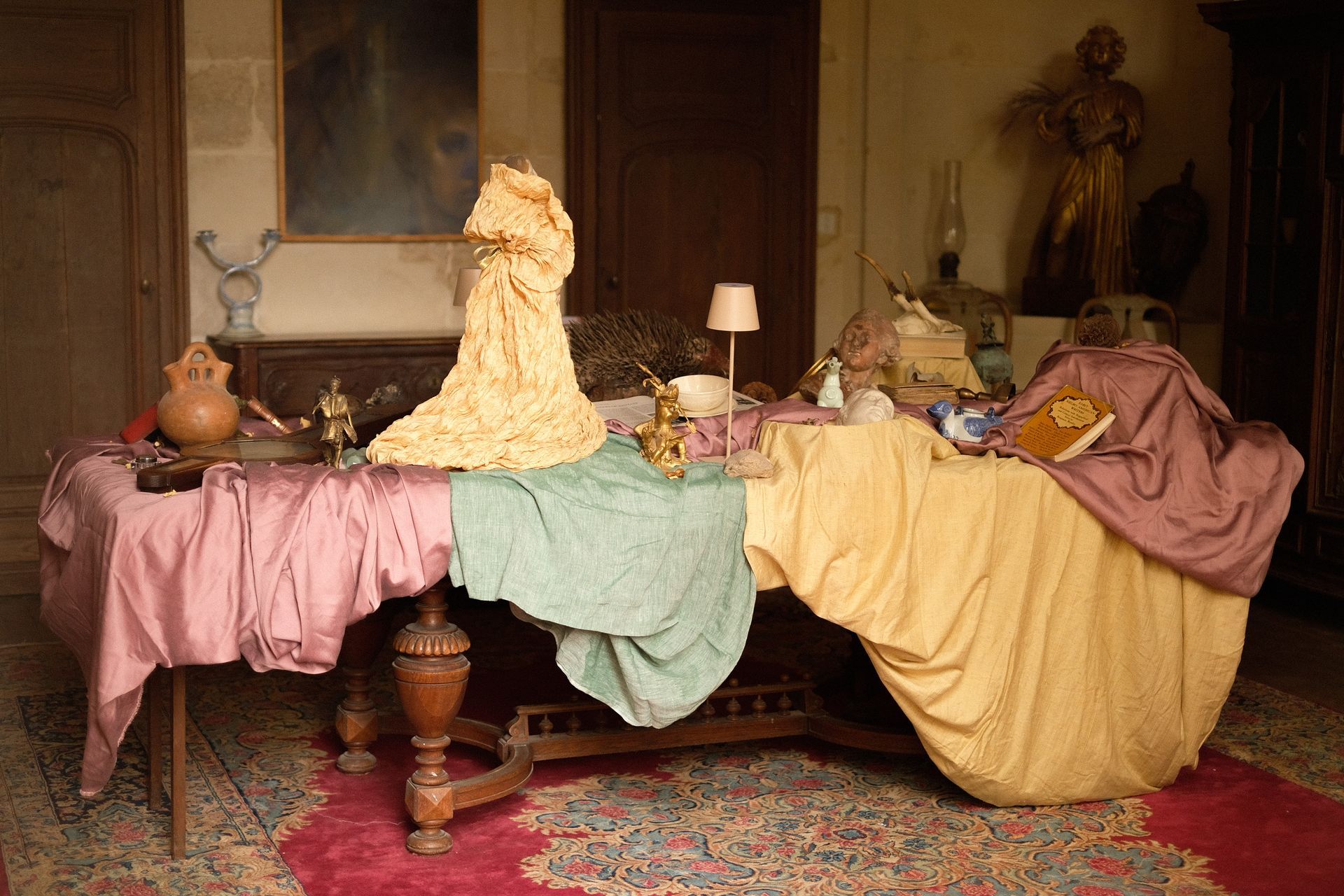
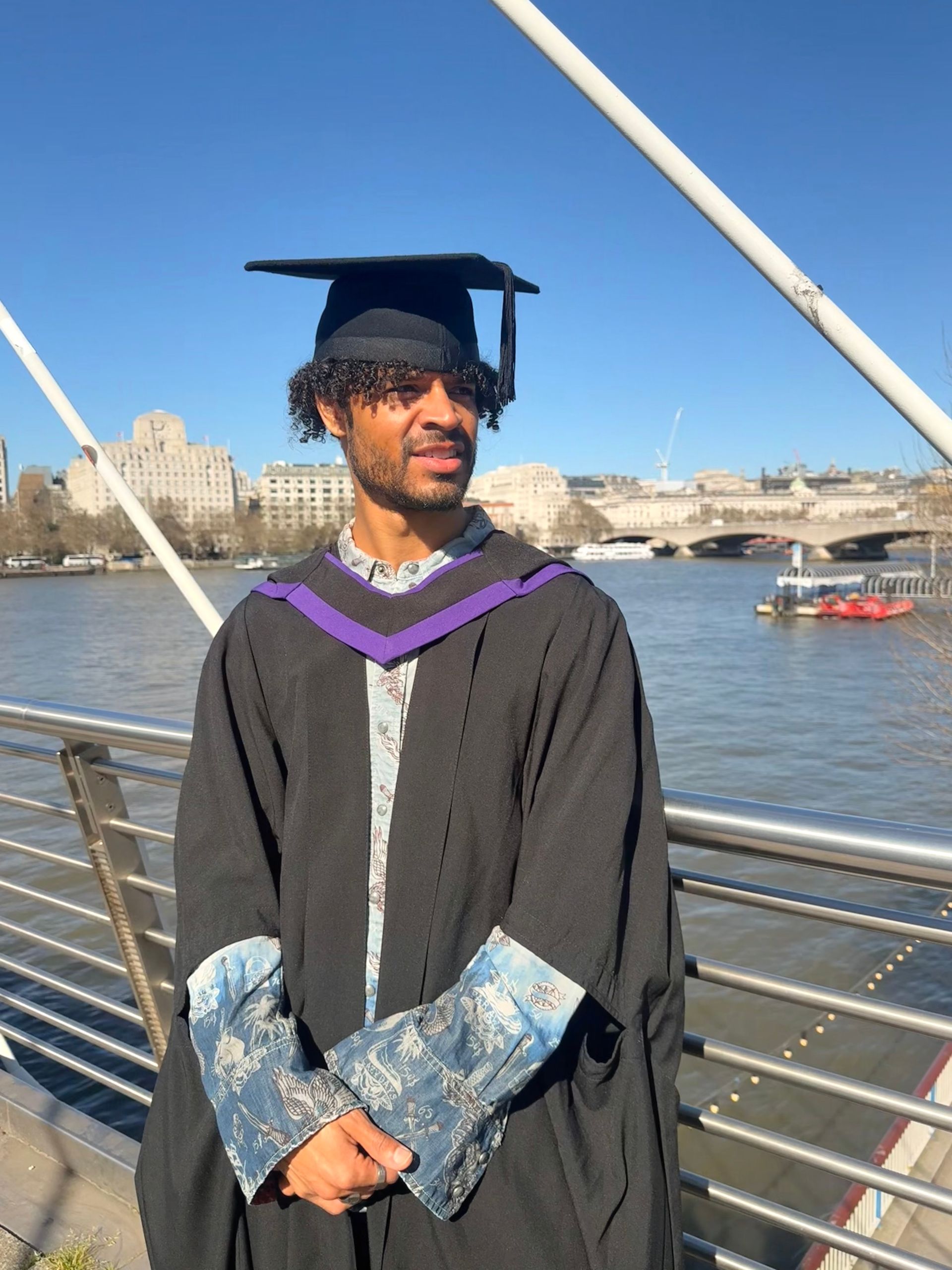
Présentation d’archives de la Maison Saint-Joseph was developed during my residency at Maison Saint-Joseph in Crépy-en-Valois, France. Through intuitive staging, juxtaposition, and speculative meaning-making, the exhibition functioned as a situated, embodied archive of my time there.
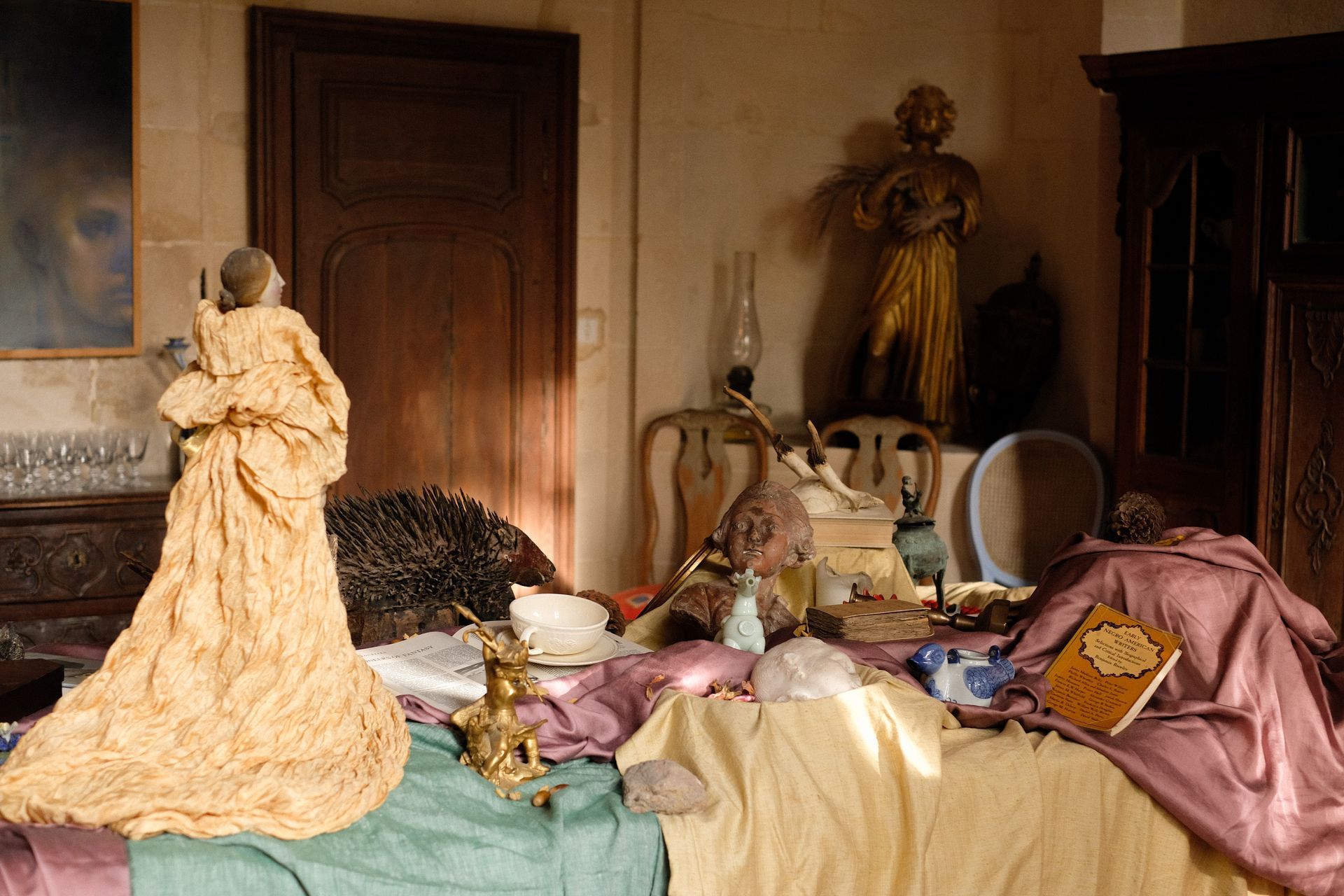
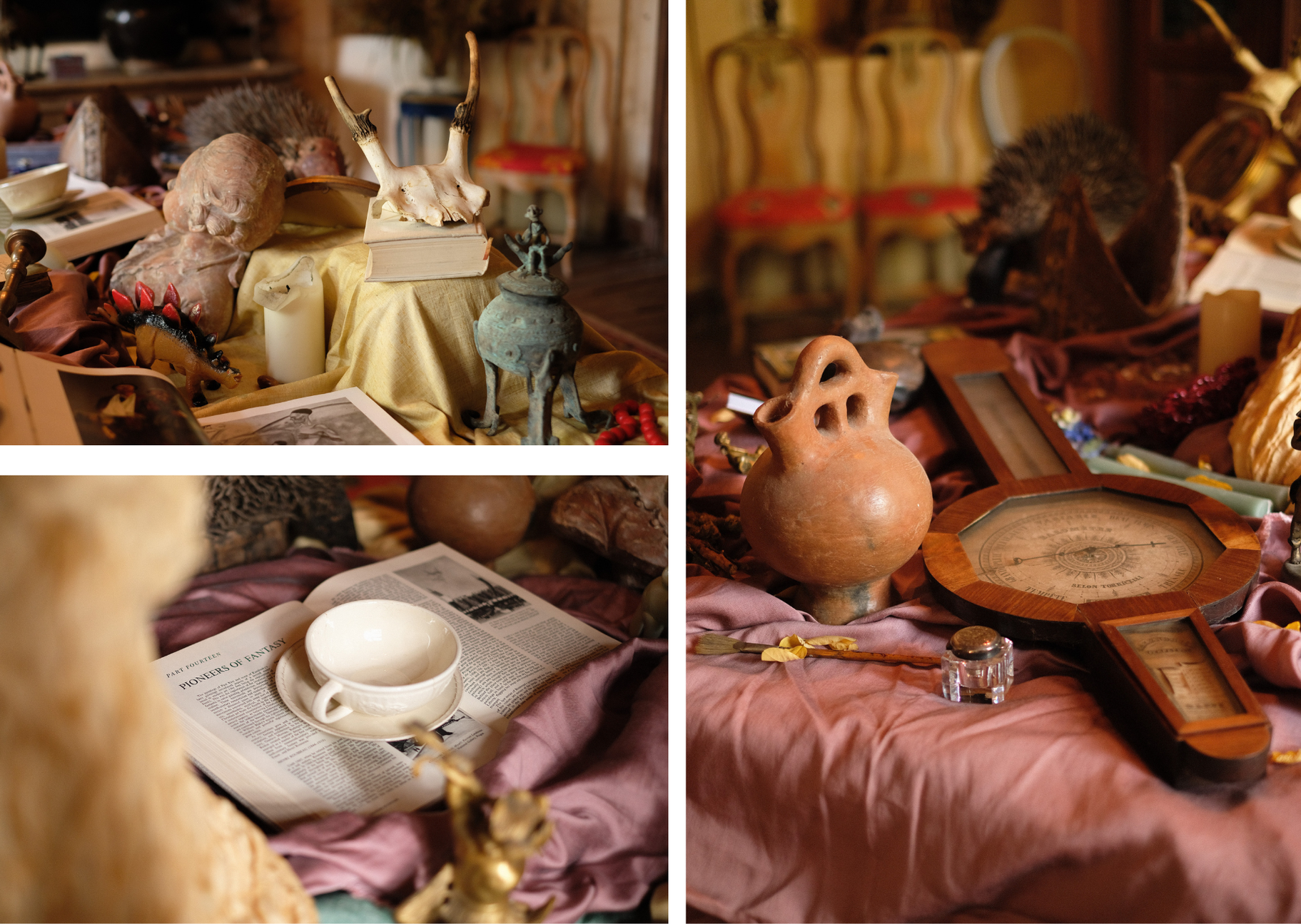
This display took place on an approximately 10-foot wooden table in the residency’s formal dining room. Draped with mustard yellow, mint green, and light magenta curtains, more than 30 antiques, ephemeral items, and decorative objects from the site’s collection were arranged across the table. Books were slipped beneath the fabric to create varied elevations, producing a maximalist, almost childlike sense of curiosity and discovery.
Rather than presenting the collection of objects through a fixed, historical lens, a more responsive approach was taken in which formal decisions could be made alongside the discovery of truths, both historical and theoretical, that existed within each object.
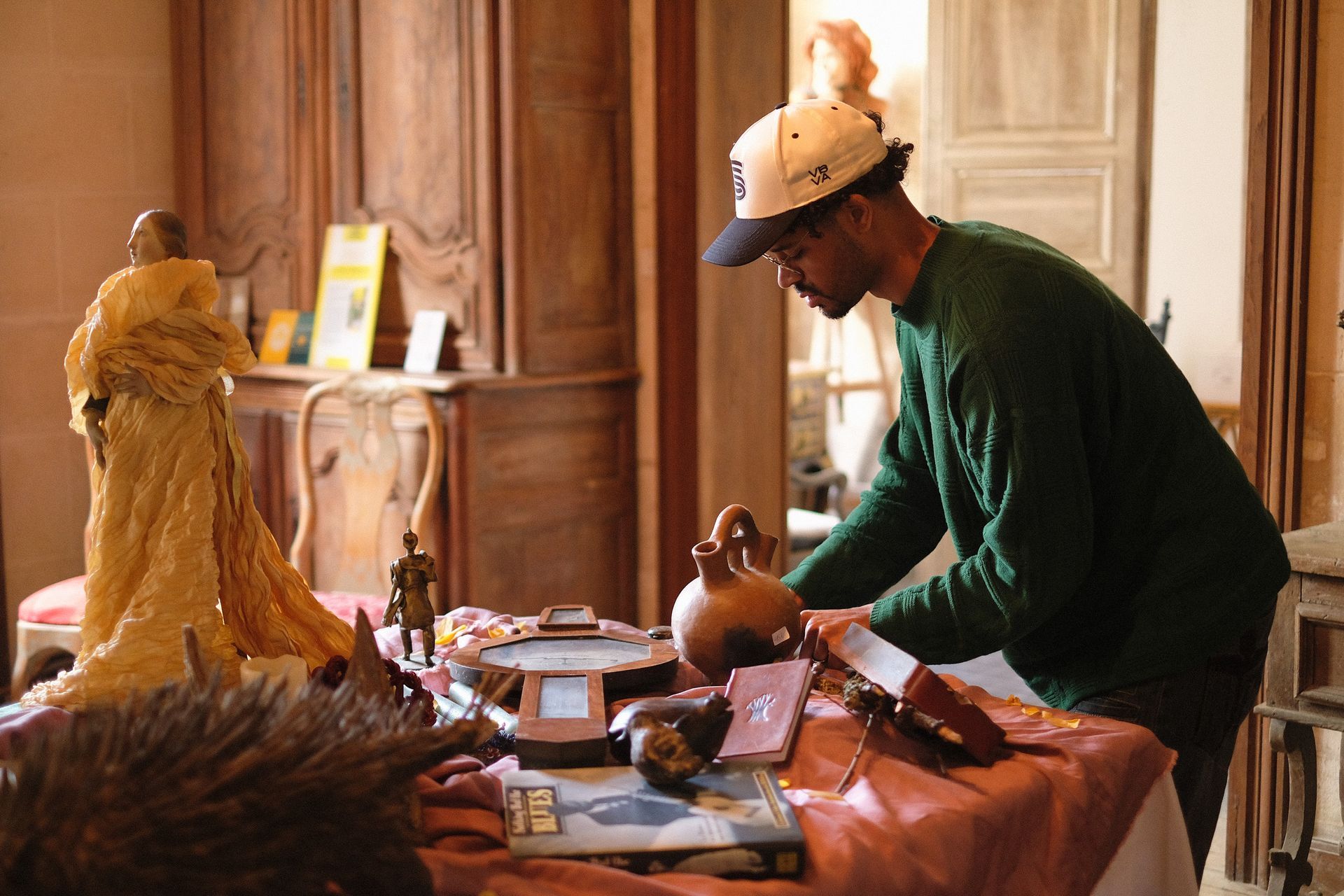
In order to address existing gaps in knowledge, research unfolded through both primary and secondary methods. I interviewed residency staff about the origins of objects while also conducting further historical research online. My findings were captivating; layered with cultural practices that were unbeknownst to me as well as sinister, colonial entanglements that always leave room for postulation.
The objects selected were those I encountered daily: reproduced fine china, books I was actively reading, sticks from the fireplace, acorns and petals gathered outside, pre-modern technologies including an antique banjo barometer and a glass inkwell were used along with miscellaneous objects such as animal skulls, indistinct candles, costume jewelry, and toy dinosaurs. I also used items I discovered that the site’s owners themselves were unaware of, such as a handwritten copy of a Molière play script from 1840 (which was moved into a preservative state after the exhibition) and items collected during the previous owner’s travels to Morocco including paintings, figurines, and ceramics.
This final assemblage reflected not only what I saw inside the house, but the totality of my experience: reading, wandering, observing while inhabiting this fascinating fortress.
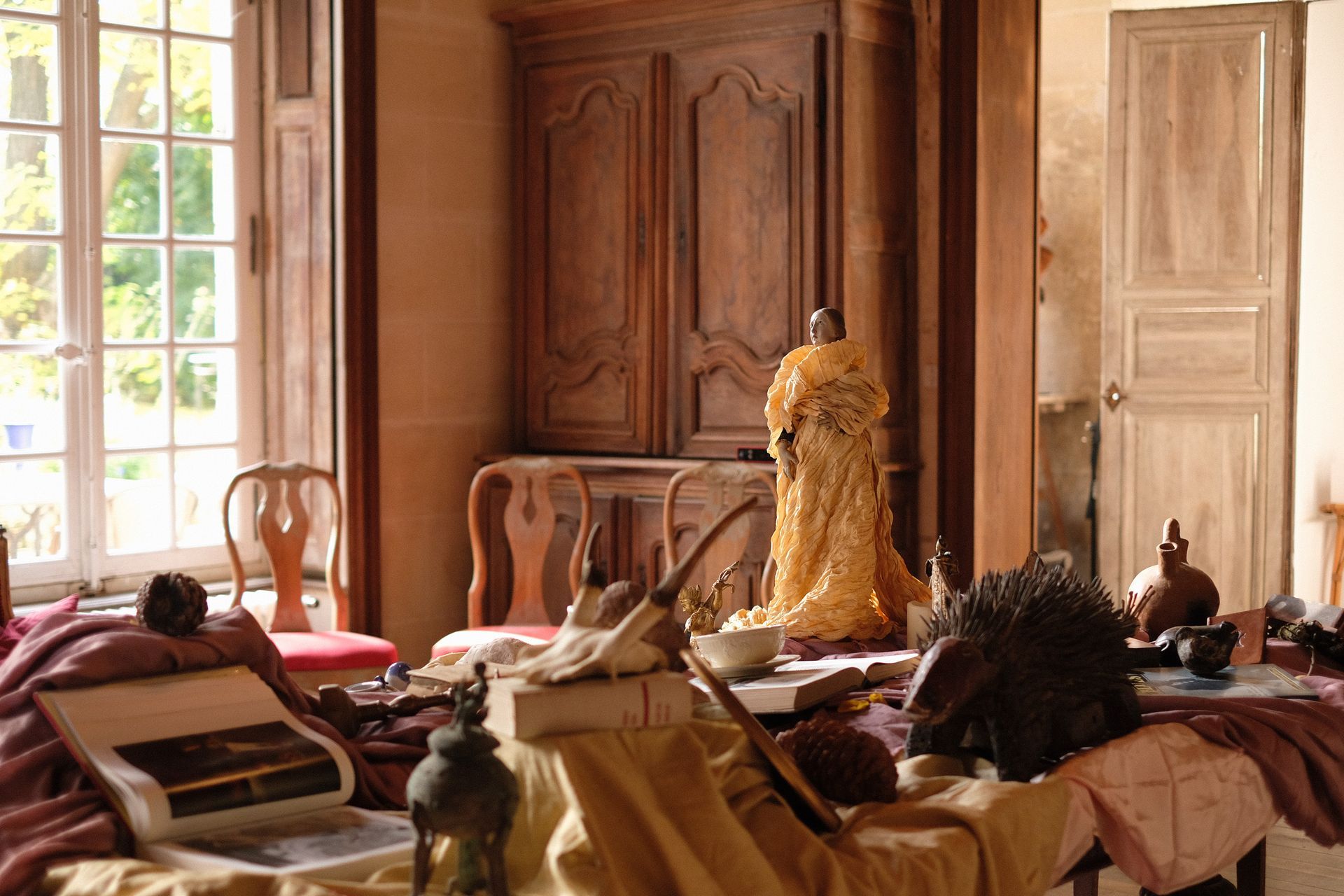
The project emerged from an initial exercise of “spider poems,” a technique that examines space relationally: how objects exist in proximity to one another, how they guide movement and attention, and how I, as an actor within the space, am implicated within those relations. This approach allowed for a semi-spontaneous form of analysis, one that prioritized intuition and spatial thinking over linear explanation. Moreover, due to a language barrier, I was tasked with creating something that could exist visually and conceptually without requiring verbal exposition – an installation that could speak through composition alone.
Drawing on the spatial design skills I’ve developed through years of exhibition-making – often working with furniture, books, archival images, and ancillary objects alongside contemporary art – meaning was generated through the relationality of the objects, functioning as coalescing prompts. In this way, the exhibition reflects an understanding of the curatorial as a mode of continual exploration whilst in the process of arranging.
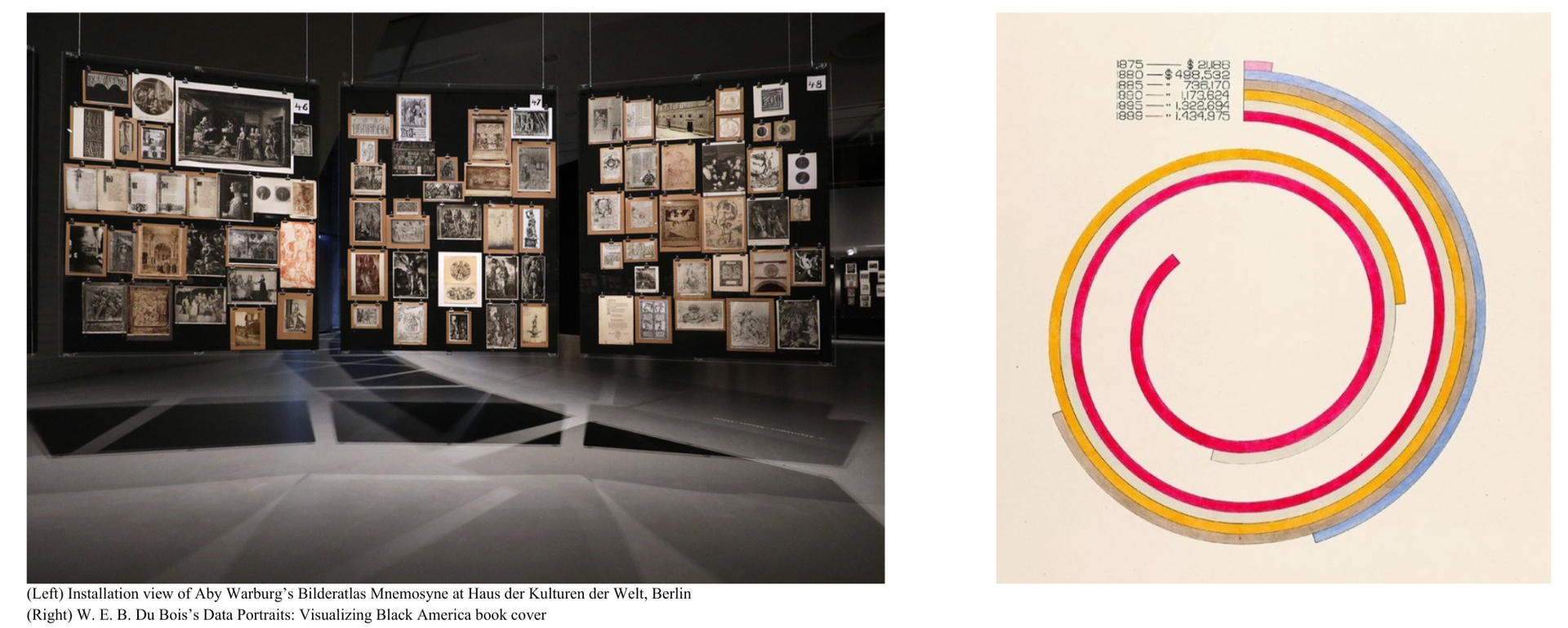
Conceptually, the project is informed by the methodologies of Aby Warburg’s Bilderatlas and W. E. B. Du Bois’ Data Portraits. Like Warburg, I assembled images and objects into a polymorphic configuration; and like Du Bois, I embraced subjective diagram(s) as a valid analytical tool. The resulting display tells an abstract yet holistic narrative that puts question to what stories I am responsible to tell.
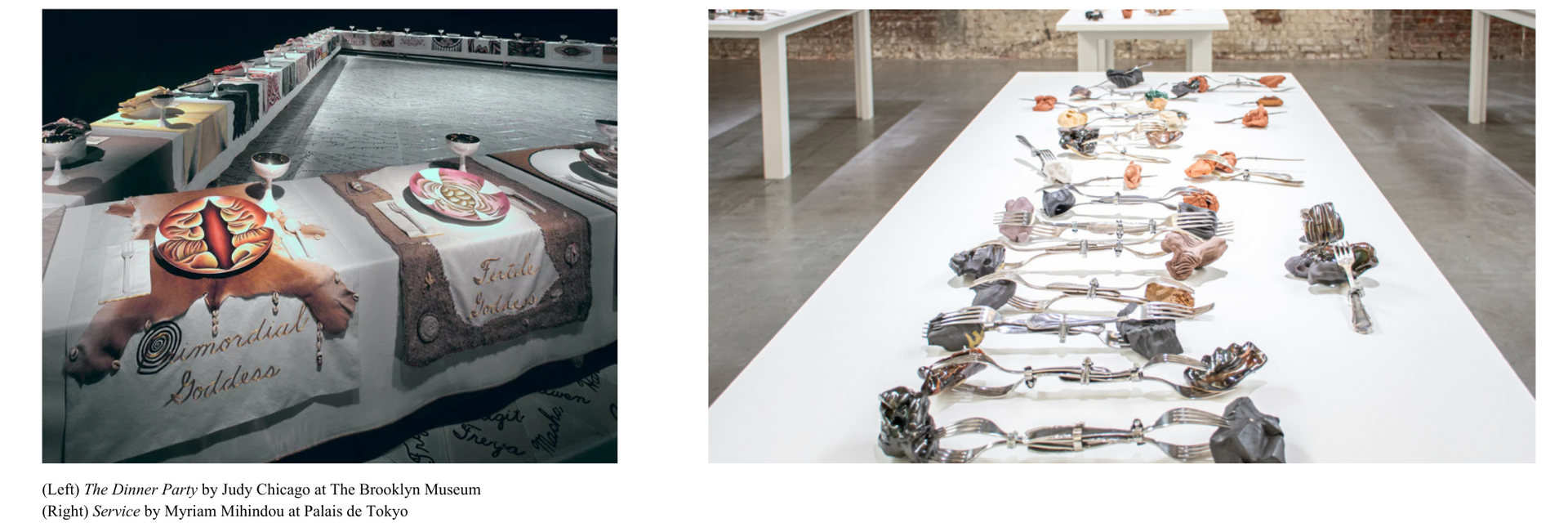
The table itself became a central, conceptual device. Its function draws from ancient and pre-modern examples such as Egyptian offering tables and European specimen tables, while also holding feminist and decolonial legacies in contemporary art. Works such as
The Dinner Party by Judy Chicago and Myriam Mihindou’s site-specific rendition of
Service at Palais de Tokyo provided critical reference points for understanding the table as a site of communal memory, power, presentation, labor, and generosity. Innately approaching this work from these frameworks the objects selected for inclusion were chosen to conceptually challenge hierarchies of necessity, aesthetic beauty, and candor.
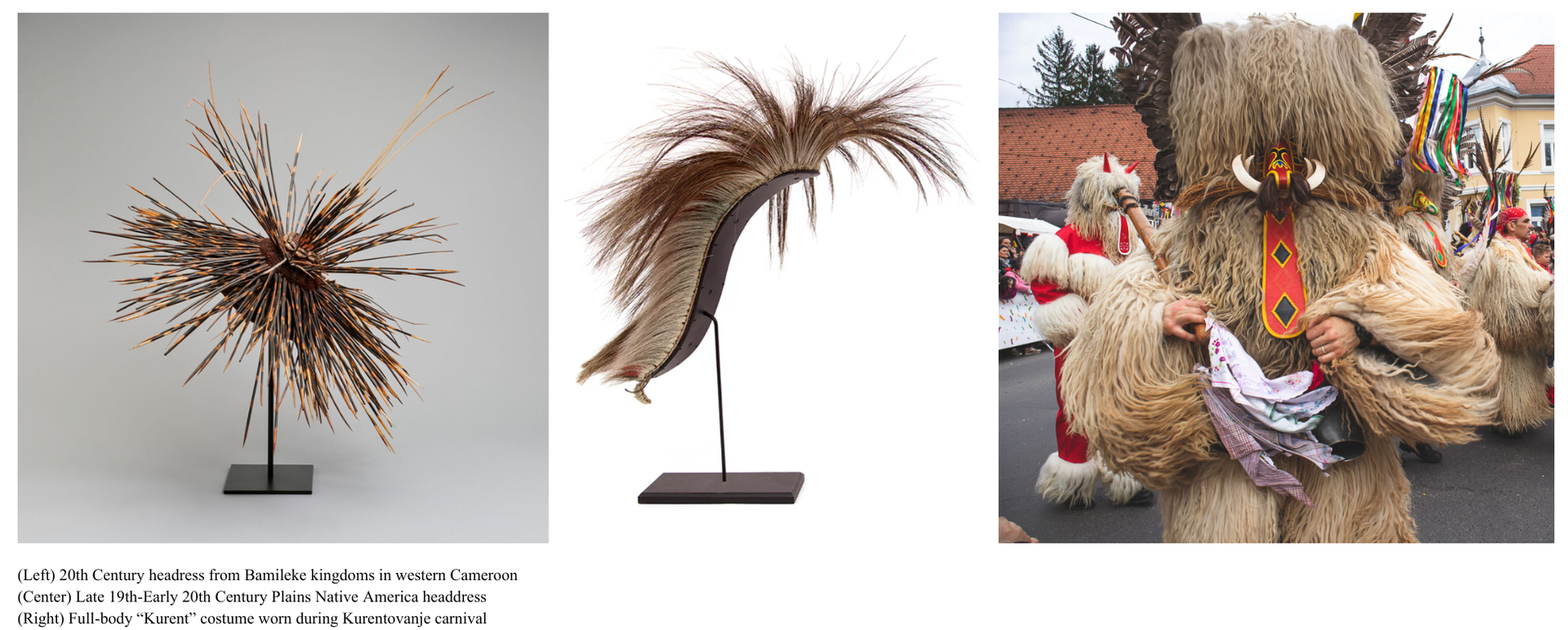
One particularly gripping object was a porcupine headdress of unknown origin. In an attempt to uncover its origination, research led me to find that porcupine quills are used on garments and headdresses as a sign of political power and distinction in the Grassfields of western Cameroon. Similarly, a number Indigenous nations such as the Wyandot, Mohawk, and Pawnee use porcupine guard hairs in headdress regalia, as well, costumes worn during Slovenia’s winter festival, Kurentovanje carnival, resembled that of a porcupine.
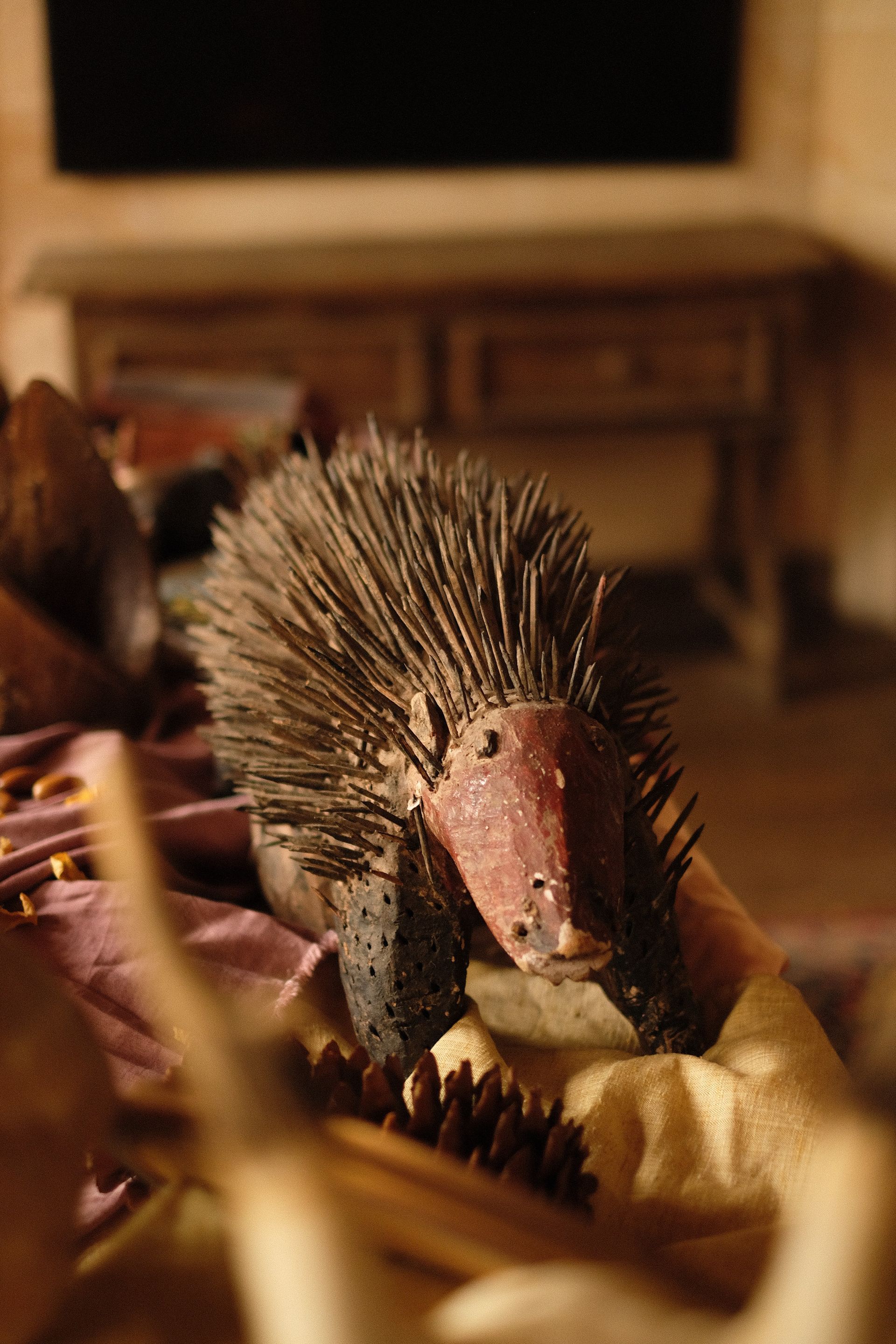
Considering France’s colonial presence in Cameroon and its historical footprint in the Great Lakes and French Canada regions, I allowed myself to speculate on how such an object might have come into existence in Crepey – maybe a French artisan came into contact with these cultures during a colonial escapade and transported it to France. Fictional, but historically rooted, this act of speculative storytelling became a way to ground myself within shared diasporic histories.
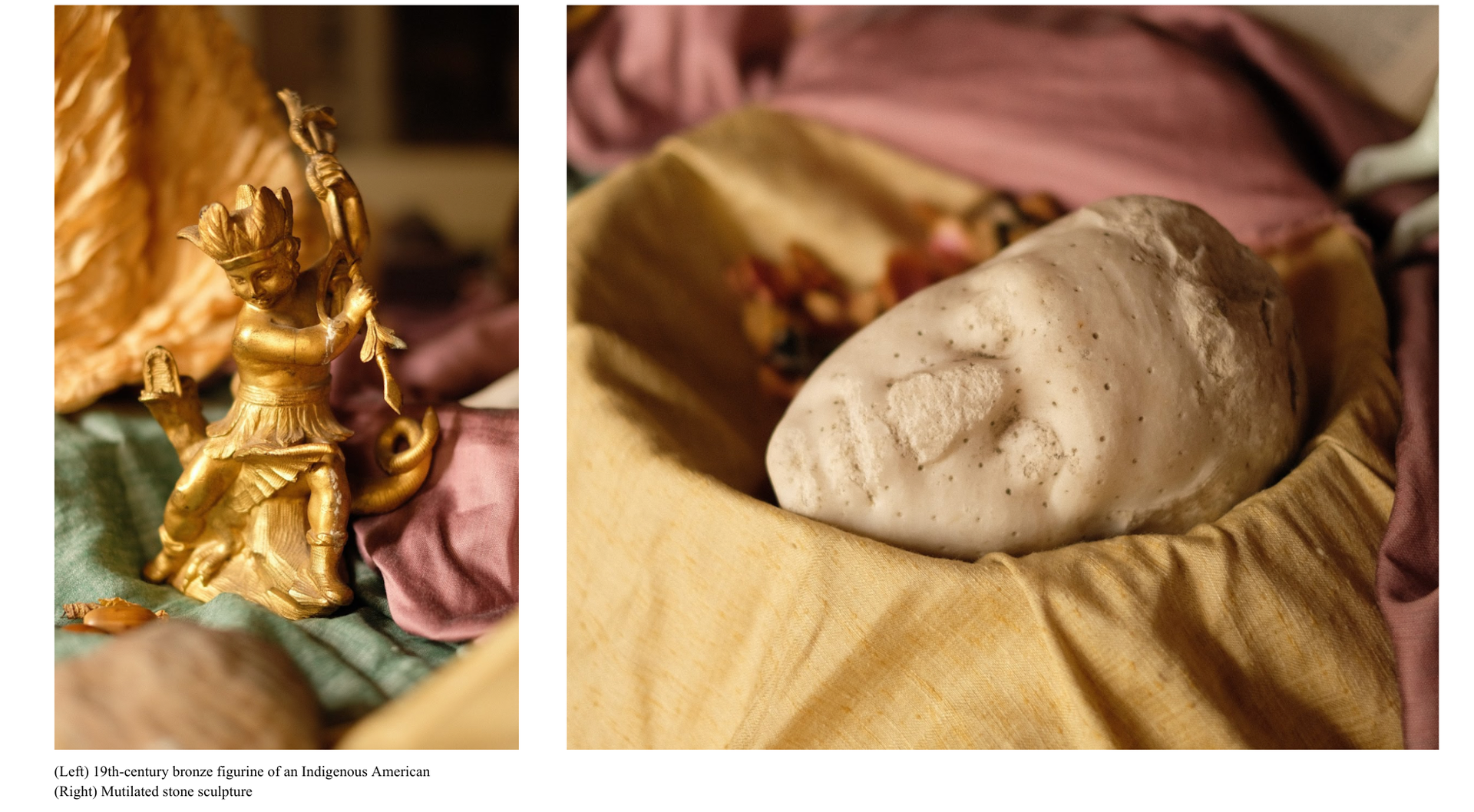
Other objects provoked confrontations with violence and power. A sculpture of a man with his nose cut off – a practice used by artists to strip an object of its esteem when it was deemed imperfect – recalled medieval practices of mutilation as punishment and dishonor. This immediately reminded me of the paramount yet amusing story of Justinian II, who famously had his nose cut off as a means of abashment and barring him from ruling after being deposed of his position of Emperor of the Byzantine Empire, only to return to power with a prosthetic gold nose. More solemnly, a 19th-century bronze figurine depicting an Indigenous American battling a serpent represented the mass-produced, exotification and othering of Native American peoples during a time of violent genocide and cultural erasure. Made popular during the era of the Indian Removal Act, the Trail of Tears, and the Wounded Knee Massacre, these edition statuettes depicted a decontextualized interpretation Native American culture and history. These encounters forced me to reckon not only with the brutality embedded in decorative and collectible objects, but also with histories directly related to the land I call ‘home’.
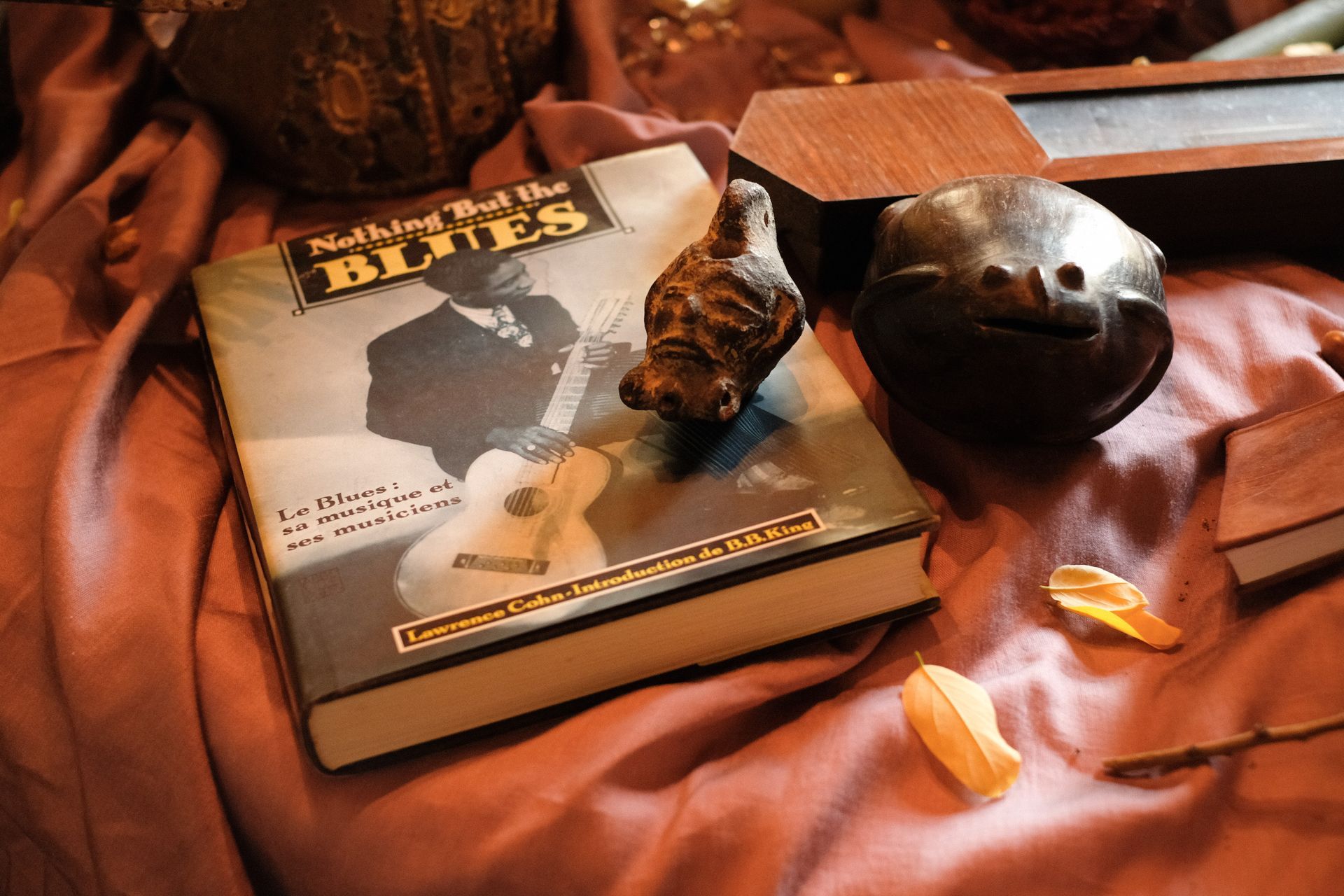
The exhibition also reflects my exploration of contemporary parallels to 1920s-1930s, Interwar Period art-making. Shaped in part by research into assemblage practices and my travels through Eastern Europe, the inclusion of texts on Cubism, collage, Surrealism, and Russian Social Realism reflects my engagement with the residency’s library and resonates with my ongoing research into the resurgence of fascism, culture wars, censorship, and the suppression of artists’ voices. Alongside these were texts including
Nothing but the Blues
and
Early Negro American Writers (a text from my personal library), which highlighted Black cultural production in the United States pre-World War II. Together, this exploration emphasized the interconnectedness of art and cultural production during a period in which artists were navigating modernity and authoritarianism. These concerns felt especially urgent in light of recent censorship controversies, such as the relocation of Amy Sherald’s retrospective from the Smithsonian Institution to the Baltimore Museum of Art.
In this way,
Présentation d’archives de la Maison Saint-Joseph aligns with exhibitions such as
Mining the Museum by Fred Wilson, which activate objects’ latent histories through curatorial intervention. Yet here, the intervention is explicitly personal – the selection, configuration, and examination of objects was determined by my presence, my intellectual and emotional stake in the space, and where I felt it most appropriate to invest more time into discovering these objects’ implications.
Ultimately, this project marked a pivotal growth in my practice. By using a critical-creative approach to aesthetics, staging, and meaning-making, I discovered a new capacity to create perspective in addition to creating a dynamic presentation. This mode of working allowed me to explore new storytelling tools, especially when not working with contemporary art nor artists. I consider this exhibition a ‘second becoming’: one in which the curatorial operates as a method for understanding worldly intricacies, and where my practice can exist within their exploration.